Tomatopalooza Tips & Tricks

Posted on by

Spring in Northern Arizona’s unpredictable high-desert climate means cultivating tomatoes can be both a unique challenge – and a deeply satisfying success. And if you’re passionate about tomatoes, there’s even more to love: these garden staples have a fascinating history and global footprint that might just surprise you.

To get the most from our short tomato-growing season, select plants that perform well in cooler climates or have a shorter maturation period, such as Early Girl, Siberian, Better Boy, Celebrity, and Stupice. Meanwhile, Sungold and Sweet 100 are cherry tomatoes known for their sweet flavor and rapid yield.

Tomato Trivia: Tomatoes come in a wide array of colors – including yellow, orange, green, purple, black, and striped varieties. Try some Black Brandywine heirlooms or bite-sized Sungold varieties.

Getting a healthy crop in this region means being mindful of elevation, frost dates, and water conservation. Start indoors and transplant only after the danger of frost has passed (typically by mid-June). For unseasonably cold weather, frost cloth, water-filled season extenders, or cold frames can help shield your plants.

Irrigating wisely will help your plants thrive, and we always advise using a drip irrigation system, which ensures deeper, more even watering while conserving this precious resource. We also suggest rotating your crops and avoid planting tomatoes in the same soil year after year. It will make your garden more productive and reduce the risk of disease buildup.

Tomato Trivia: Tomatoes have been cultivated since at least 700 A.D., originating in South and Central America. The Aztecs were among the first to grow them for food. Thomas Jefferson was an early champion of tomatoes in America, growing them at Monticello and helping to popularize their use in American cooking.

Northern Arizona growers can expect a few bumps in the road during the growing season:

  • Cool Weather Yellowing or Purple Leaves: Usually a sign of phosphorus deficiency that corrects itself as the soil warms.
  • Pests like Aphids and Whiteflies: Use insecticidal soap or remove them manually.
  • Fungal Issues such as Early Blight: Remove infected plants promptly to prevent spread.

Tomato Trivia: For a very long time, tomatoes were considered poisonous in Europe and were prized more as a decorative plant instead of a food source – even in Italy! There are multiple reasons why – botanists were worried because they (correctly) identified tomato plants as being related to deadly nightshade. Meanwhile, the acid in tomatoes caused lead to leach out of pewter plates, which did indeed cause illness, even if it wasn’t the tomato’s fault.

Warner’s Nursery is proud to present Tomatopalooza, our annual Memorial Day weekend event celebrating all things tomato! It’s a chance for gardeners of all levels to come together, browse dozens of tomato varieties, and get expert tips on maximizing their harvest.

Tomato Trivia: Last piece of tomato trivia for you. Tomatoes have been to space; American astronaut Frank Rubio cultivated the red beauty on the International Space Station. The Ziplock bag containing his harvest disappeared, however (and Rubio was even accused of eating it), but it turned out that in the weightlessness of space travel, it floated away and got lost. It was eventually found, and Rubio was cleared of any vine crimes! 

The big takeaway from Rubio’s story is that with a little patience, some planning, and the right guidance, you can pretty much grow tomatoes anywhere – even in northern Arizona.

So let’s get growing, and we look forward to seeing you at Tomatopalooza!

Happy Gardening,
Misti
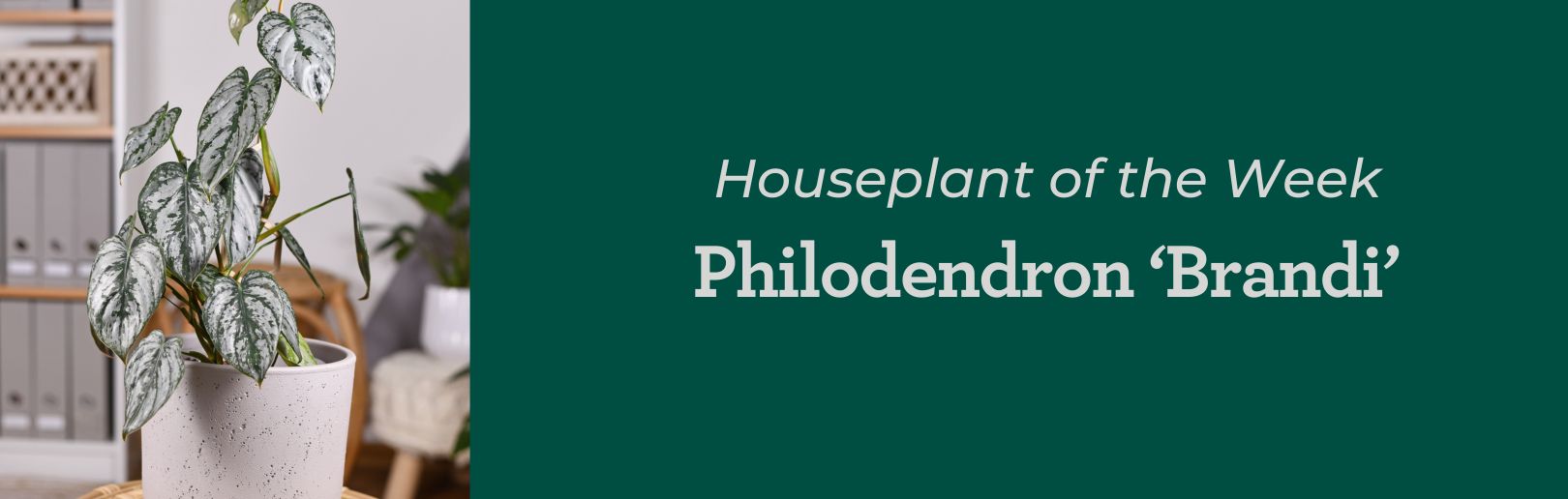
Houseplant of the Week: Philodendron ‘Brandi’

Posted on by

The Philodendron ‘Brandi’ – a shortening of its scientific name Philodendron Brandtianum – is also known as the Silver Leaf Philodendron, thanks to its heart-shaped leaves that are distinctly dominated by white or silver variegation.

This philodendron is a climber – in its native South America its an epiphyte that is found hugging trees – and as a houseplant it works well as a potted plant or a hanging plant. Either way, it will grow about four to five feet quite quickly.

Caring for Your Philodendron Brandi

  • Light: The philodendron brandi enjoys bright, indirect light.
  • Water: Give your plant a good drink of water when the first couple of inches of soil are dry.
  • Humidity: Like most philodendrons, this plant prefers warm and humid conditions. In low humidity northern Arizona, it’s a good idea to use a pebble tray.
  • Soil: Well-draining soil is essential for this plant to avoid root rot.
  • Fertilizer: While this plant doesn’t necessarily require feeding, a well-balanced indoor plant fertilizer during the spring and summer growing season will help with leaf development and overall growth.

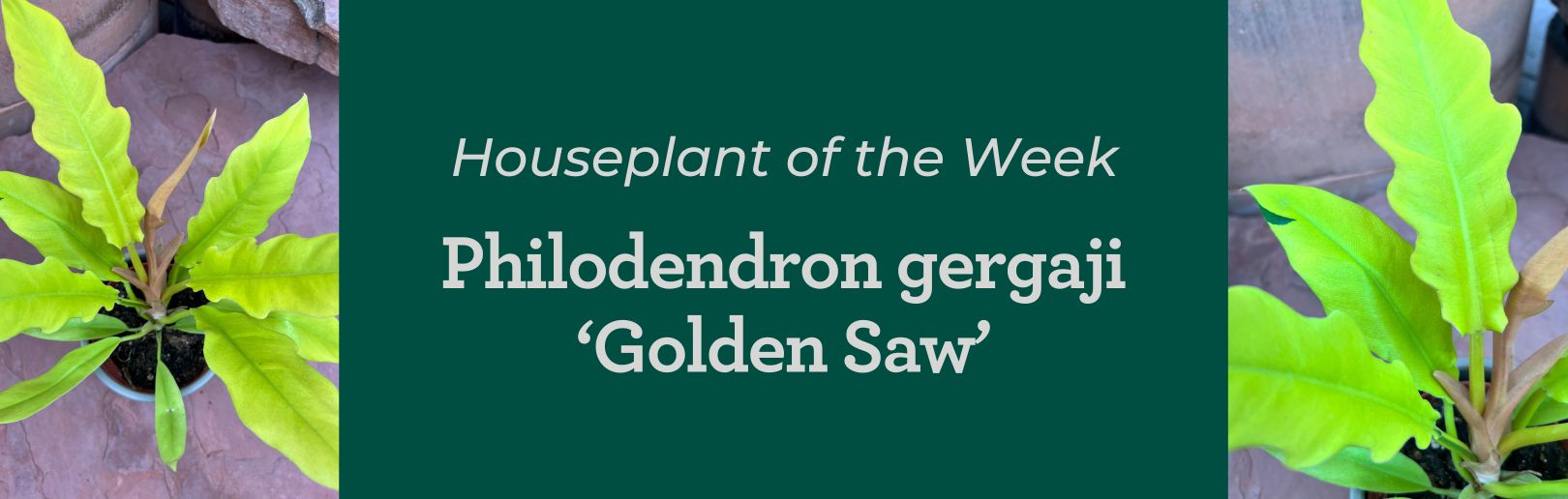
Philodendron gergaji ‘Golden Saw’

Posted on by

This vibrant plant with its lemon and light green wavy leaves glows with a radiant brightness. Compact and eye-catching, its elegant, arching foliage adds charm and color to any indoor space and is ideal for tabletops, shelves, or bright corners.

Like most philodendrons, this variety is easy to care for, making it ideal for beginners. 

Here are some guidelines when cultivating your Golden Saw.

Light: While her golden-lime leaves tolerate lower light, your Golden Saw would prefer bright indirect light. No direct sunlight, however, or those leaves will burn.

Water: Water when the first inch of soil dries out. During the dormant winter months, reduce watering frequency. Make sure the pot has proper drainage to prevent waterlogging and root rot.

Feeding: Feed once a month during the growing season (spring to summer) using a balanced liquid fertilizer applied at a weak strength. Avoid fertilizing during the winter months when the plant’s growth slows.

Houseplant of the Week: The ‘Sensitive’ Plant

Posted on by

Ah, the sensitive plant. Reader of romantic poetry, easy to upset, spending long hours in its room obsessing over comments in its Instagram feed . . .  oh wait, no, that’s a sensitive teenager.  Sorry, got them confused.

The fabulously named Mimosa Pudica (which sounds like an alcoholic beverage and a dessert all rolled into one) is commonly called the “sensitive plant” or the “touch-me-not.” Why? Well as you can see in the video above, it features this intriguing trick: at the slightest touch, its feathery leaves will quickly close together. The name is a Greek/Latin hybrid term meaning “bashful mime.”

And while they’re sensitive, there not too sensitive. Leaf closing aside, mimosa pudica is pretty easy to grow and lovely to look at. Here’s the basics:

Caring for Your Sensitive Plant

  • Mimosa pudica likes soil that can hold enough water to remain consistently moist while providing good drainage to prevent root rot. Self-watering pots are a good choice for this plant.
  • Our sensitive plant loves light and if it doesn’t get enough, it will close those fern-like leaves and fail to bloom with pretty pale pink and purple flowers. East facing windows that get lots of morning light will keep it happy.
  • This is a native of the tropics and it likes its humidity. Placing it near a humidifier or misting periodically will help it feel at home even in our high desert.
  • A diluted high-potassium fertilizer (like you would use for tomatoes) is a great choice because the plant’s movement requires energy.
  • Often sensitive plants are houseplant annuals because they decline after blooming in the summer. However, it is easy to propagate new plants from their seeds.

Houseplant of the Week: Dwarf Japanese Juniper

Posted on by

You probably think of junipers as being outdoor plants, those trees and shrubs that grace your garden with their trailing blue-green needle-like foliage. And while you can plant Dwarf Japanese Garden Juniper outside, they are also highly prized as a bonsai specimens that can be grown indoors.

Well known for their low-maintenance needs and slow growth rate, these plants will thrive inside as you get the light, water and temperature right.

Caring for Your Dwarf Japanese Juniper

  • Light: This is a plant that loves its sun, so make sure that you position your plant where it will receive full sun for at least part of the day.
  • Water: Getting the balance right for Dwarf Japanese Junipers involves making sure they get enough water without overwatering. Make sure they are in well-draining soil to avoid root rot. Saturate thoroughly and then allow the soil to dry out slightly between waterings.
  • Humidity: Juniper bonsai like higher levels of humidity, so you can supplement your watering scheduled by misting the leaves every few days.
  • Temperature: This plant needs warmth as well as sunlight. Typically room temperature is ideal, but avoid placing your plant near a window or door when the temperatures drop.

It’s a Perfect Time to Start Your Herb Garden

Posted on by

Spring in northern Arizona means unpredictable weather. Fortunately there is a fun, easy, and delicious bit of gardening you can do no matter what the weather is like outside – start an indoor herb garden.

It’s also kind to your wallet. Fresh herbs at the grocery store can be pricey, and growing your own not only saves money, it will provide you with a constant supply of vibrant, flavorful herbs to add to your soups, sauces, salads, and more.

Growing herbs indoors is a lot easier than you might think. Start with a container at least 6 inches deep to give those roots room to stretch. Make sure your container has drainage holes and fill with topsoil, compost, and a bit of sand to keep things light and well-draining. Herbs don’t like soggy roots!

To create a thriving herb garden, it helps to think of your herbs like a quirky little family; each member with their own likes and dislikes. 

The Mint Plant Family (includes: basil, sage, peppermint, spearmint, thyme, marjoram, and lavender). These Mediterranean beauties thrive in drier soil and do well in smaller containers that dry out faster. The best part? The more you harvest them, the more they grow! Snip just above the nodes and watch them branch out.

The Carrot Plant Family (includes: parsley, cilantro, dill, fennel, and anise). These herbs grow deeper roots and prefer more moisture. When summer rolls around, you’ll be treated to sweet-smelling flowers that pollinators love.

The Daisy Plant Family (includes chamomile, calendula, echinacea, dandelion). These tea-time favorites are slow growers but well worth the wait. Once established, they’re fairly drought tolerant. 

The Onion Plant Family (includes chives, onions, and garlic). Hardy and easy to grow, these are perfect for beginners. They share similar needs with the Mint family – well-drained soil and a little breathing room.

Knowing whether your herbs are annual (one-season wonders) or perennial (garden companions for years to come) helps with planning. Annuals like cilantro and dill need to be replanted each year, but grow quickly and are great for immediate gratification. Perennials like thyme and rosemary can keep growing season after season with a little TLC, even if they nap through the winter.

We have plenty of herb seeds and seedlings here at Warner’s Nursery. So stop by and begin your herb adventure today. Your taste buds – and your wallet – will thank you! 

Happy (Indoor) Gardening,
Misti

Houseplant of the Week: Pilea Moon Valley

Posted on by

Pilea Mollis is better known as Pilea Moon Valley, a name inspired by the deep dimples in its leaves that look like craters on the moon. It’s bushy leaves only grow a few inches and the plant remains relatively small, making it perfect for window sills.

Caring for your Moon Valley:

  • This plant likes bright, direct light and will tolerate medium light, but no direct sunlight, please.
  • Water up to two times a week, keeping the soil evenly moist.
  • This plant prefers high humidity, so consider a location where it will get lots of moisture (like a bathroom) or use a pebble tray or humidifier to keep it happy.

Houseplant of the Week: Pink Paradise

Posted on by

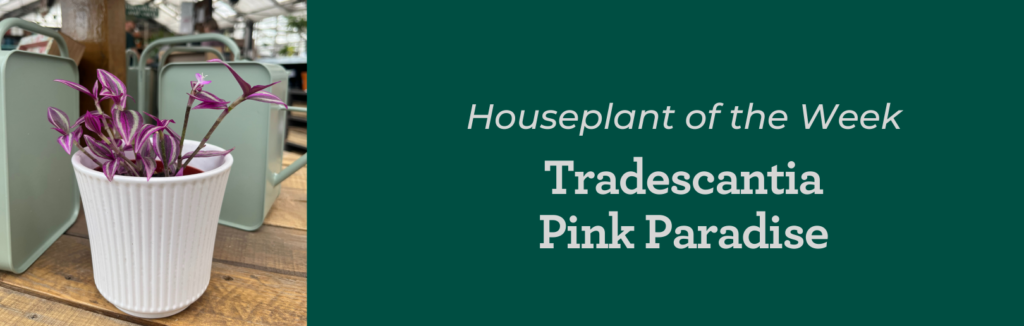
Petite and pretty, ‘Pink Paradise’ is a colorful cultivar of the tradescantia “zebra” plant – except this time the zebra’s stripes are bright pink and green.

The foliage gently cascades over the edge of pots, making it perfect for elevated containers or hanging planters, which accounts for one of its nicknames, the “Wandering Dude.”

In addition, this plant is easy to care for and grows quickly (up to 12 inches high and 24 inches wide).

Here are some guidelines for cultivating your Pink Paradise:

Light: Part of the succulent family, Pink Paradise needs bright, indirect sunlight when grown indoors. As with many plants, you should avoid direct sunlight, which could damage those beautiful leaves.

Water: Give your plant a good watering, but then let it dry out before watering again.

Soil: A specialized succulent potting soil is ideal, but any good, fast-draining mix will work.

Temperature/Humidity: Warm and cozy are the watchwords for Pink Paradise, which also likes humidity, so a pebble tray or humidifier is a good idea for your plant.

‘Porchscaping’ with Container Creations

Posted on by

After months of cold weather, and a lot of late season snow, many of us are itching to get our hands in the soil and add some much-needed color to our outdoor spaces.

While it might not be time to go all out with in-ground planting just yet, container gardening is a fantastic way to satisfy that early-season urge to plant.

Which is why I’m so excited that we’ve just gotten 24 pallets of beautiful pottery! This means there are endless options for adding some personality to your porch, entryway, or patio with stylish containers. Whether you prefer classic neutrals or bold, vibrant designs, there’s a perfect pot waiting for you.

The best part? When the weather warms up and it’s time for summer blooms, I don’t just toss out my early-season plants—I replant them in my yard. Genius, right?

If you choose to plant shrubs or perennials in your containers, they can stay put year-round. Just swap out the annuals when the season changes. One of my go-to combinations is a neatly sheared boxwood paired with pansies and violas for a classic, timeless look. If you prefer shade-loving plants, try layering hostas with Heuchera and Brunnera, and add a trailing vinca for extra texture and movement.

One of the most visually appealing ways to enhance your porch is by layering pots of different sizes. A simple combination of large, medium, and small containers arranged together creates depth and interest. Mix and match plants with varying heights and textures to make a striking display that evolves beautifully throughout the seasons.

So why wait? Get outside, grab a pot, and start planting – spring is calling!

Happy Gardening,
Misti

New Garden, New Adventure

Posted on by

This year’s garden planning will be a whole new world for me. Well, maybe not a whole new world, but definitely a new property and a new micro-climate!

Last year, my family moved from a house in Ponderosa Trails to a sprawling property in Doney Park.

Moving to a new home is always an adventure, but when that move includes six acres of land, the possibilities for gardening and landscaping expand exponentially! Our new home is so different from our last, and I’m absolutely loving planning this season’s garden. 

(By the way, if you are getting ready to plan YOUR garden, we have an upcoming class that can help. Our Root Camp Gardening 101 session on crop and garden planning will be on March 29 at 10 pm and you can sign up for it – and many other Root Camp classes – here.)

We have plenty of beautiful Ponderosa Pine trees, just like at the old house, but now we also have Pinon, native Juniper, and open grassy areas that give the land a whole new feel. So far, we’ve focused on landscaping close to the house, adding paver patio sections, a covered outdoor patio space, and even a built-in BBQ area.

Of course we made sure that we had a drip irrigation system set up (it really is the best way to water your plants) and my husband, Dan, and I took on the re-landscaping of the front entryway. We added boulders, a dry creek, and some plants, incorporating many of the pots I brought from our old home for perennial and annual color. We even brought our beloved bubbling boulder and set it up again – a little touch of familiarity in this new space.

Of course, not everything from our previous home can be recreated here. Our old water feature, for example, just wouldn’t survive with the amount of wildlife that visits our property, particularly the elk, who would destroy it in no time. Luckily, we have a wonderful view of the Rio de Flag streaming by, which gives us the beauty of a water feature without the maintenance.

And with so much land, we can’t possibly landscape everything, so for now, we’re focusing on the areas around the house. Future plans include adding a small barn for some mini-donkeys and continued landscaping improvements. The outer property will remain in its natural state for now – we love the native look and will maintain it as best we can.

One of the biggest adjustments has been adapting to the new micro-climate. It’s incredibly windy here! Because of that, I made sure to install a drip irrigation system before planting anything. Watering is key, and I wanted to make sure new plants had a fighting chance! The plant palette has shifted as well – I need to find elk-resistant varieties and plants that can withstand the strong winds. Recently, I planted some Lavender and Catmint along a rock wall near our driveway. Not only do I think it will look beautiful, but I’m also hoping it will help keep wildlife at bay. Time will tell!

Another important factor we’ve had to consider is fire safety. The risk of wildfire is very real, and I’m taking it seriously. Before we even moved in, we had Mick’s Tree Service clear dead trees, limb up branches, and remove anything too close to the house. (Mick is also leading one of our Root Camp classes; he’ll be teaching folks how to care for their Ponderosa Pines on May 3.)

I also reached out to the Flagstaff Fire Department, which offers a home assessment service for wildfire preparedness. Mark Adams came out to the property, provided fantastic advice, and sent me a ‘Wildfire Action Plan.’ It was eye-opening! I now have a clear vision of how to landscape moving forward with fire safety in mind, and it was an invaluable learning experience for both myself and my team.

This new home has been such an exciting project, and I can’t wait to see how the landscape evolves over time. With a mix of practical planning, trial and error, and a whole lot of enthusiasm, I know our home will become something truly special!

Happy Gardening,
Misti