Category Archives: Houseplants

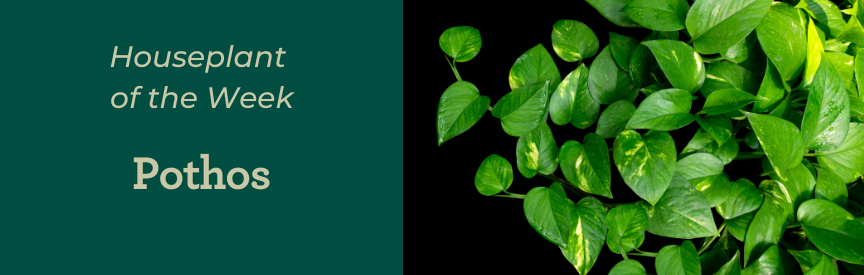
Pothos

Posted on by

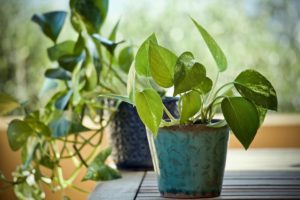
It’s hard not to love the Pothos. Their easy-going nature makes them not only a great plant for your home, but a good gift for your friends or loved ones who might not think they have green thumbs.

These versatile houseplants look great in a pot or hanging in a container (they look particularly fetching in macramé hangers, which have made a comeback.) They grow well in bright light or low light, meaning they will flourish anywhere in your home.

Caring for Your Pothos – One of their very few demands is not being overwatered, so keep the top few inches of soil dry and test the soil prior to watering. You should feed them on a regular schedule from April or May through August. Just follow the instructions on the label of your favorite plant food. (We recommend VF11 organic liquid fertilizer once a month.)

Pothos love a good misting and it’s also important to dust them when needed so they photosynthesize efficiently. This also gives you a chance to inspect your plant for any pesky pests or bugs.

Houseplant of the Week: Devil’s Backbone

Posted on by

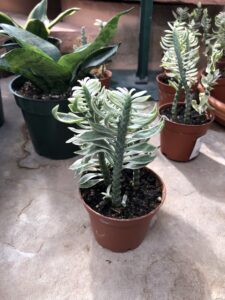
Devil's Backbone plant

In summer, the slow-growing Devil’s Backbone will sometimes develop “flowers” (really leaf bracts) that are pink or red, which gives this lovely houseplant some of its more colorful nickname’s – red bird flower and Persian lady’s slipper among them.

But most of the time, this houseplant sports variegated white and green leaves up its “spine.” Easy to grow and propagate, this plant has basic requirements and an aversion to cold.

Caring for Your Devil’s Backbone

Soil/Watering: This plant likes a nice even moisture, so in addition to a good potting mix, you might want to add a little peat most that will help spread out the water but keep the soil from being too wet. Make sure your Devil’s Backbone is in a pot with drainage holes so the soil drains well.

Light/Temperature: Room temperature and a spot out of the way of drafts is perfect. As with many tropical houseplants, Devil’s Backbone does not like the cold, but loves bright, indirect sunlight.

Food: Fertilize in the spring about every three weeks. This will help it produce those nice colorful bracts in the summer. Devil’s Backbone goes dormant in the fall and winter, so discontinue feeding at that time.

Houseplant of the Week: Watermelon Peperomia

Posted on by

Looking for an easy indoor plant that doesn’t take up too much room and comes in a wide range of colors and varieties? Then you might want to pick a peck of peperomia.

There’s well over a thousand varieties of these plants, but one of our favorites is the P. argyreia, whose silver stripes against dark green leaves make it look like a watermelon skin!

Peperomia tolerate low light relatively well, but they will be happiest in medium to bright indirect light. But don’t allow direct sunshine to hit those beautiful leaves; if given too much light, the colors and patterns that make this plant so special will fade.

Water your Peperomia sparingly. Wait until the top 50% – 75% of the soil is dry, then water until liquid flows through the drainage holes at the bottom. Discard any water that has accumulated in the saucer. Many types of Peperomia can hold water in their leaves, so it’s not a death sentence if you go on vacation or forget to water them once in a while.

Houseplant of the Week: ZZ, the Eternity Plant

Posted on by

We’ve been doing the research but we don’t know quite how Zamioculcas zamiifolia (say that three times fast) got one of its nicknames.

Not “ZZ” (that one’s kind of obvious) or “Fat Boy,” which come from the tubby little rhizomes under the soil, but its very popular name, the “Eternity Plant.”

We’re guessing, however, that it’s because you can’t kill it. Or at least you’d have to try really, really hard.

This is one of the most forgiving plants you’ll find in our nursery. Miss a watering (or three) and it still shows off it’s glossy, feathery wings. It’s not particular about soil; anything that drains well will do. It’s not even fussy about light, which makes it very popular in places where there’s little natural light, like an office cubicle, or cities where most days are overcast. It also has no identified pest or disease problems.

No wonder this beauty is the star of so many Instagram posts!

Are there any downsides? Well, yes. Much like our recent houseplant of the week, Dieffenbachia (or Dumb Cane), your Eternity plant can be an irritant to sensitive skin. You don’t need to wear gloves around it, but you probably should wash your hands thoroughly after touching it, and you definitely shouldn’t consume it, so keep it away from pets and small children.

Caring for Your Eternity Plant

  • Light: As mentioned, “ZZ” is pretty tolerant of any lighting situation, but it does its best with bright but filtered light.
  • Water: The bulbous rhizomes under the surface contain water, which is why your Eternity plant will forgive you for missing a watering, but also be careful not to overwater, because that will cause the rhizomes to rot. You’ll know if you have overwatered because the leaves will start to turn yellow.
  • Fertilizer: Feed once a month during the spring and summer growing season.

Monstera Peru

Posted on by
Banner with detail of monstera peru leaves and a monstera peru plant in a white planter

Imagine crossbreeding a monstera with a succulent. What you would most likely get is a Monstera Peru.

This plant looks quite different from your typical Monstera. It’s thick, glossy, leathery leaves do not have holes or splits like a Monstera delicosia. Instead they are solid and dramatically veined. They also are why this Monstera is pretty drought resistant, despite being a tropical plant.

That doesn’t mean you shouldn’t water yours regularly, but we recommend waiting until the two top inches of soil are dry to avoid overwatering.

Monstera Peru originates from the Amazon region (thus the name, although in addition to Peru, many of these plants can be found in other parts of the Amazon basin, like Venezuela.) They like bright, but indirect light and direct sunlight can burn those beautiful leaves.

Another benefit of this plan is that while it can grow to six or eight feet, it does so slowly, so it won’t outgrow your space for quite some time.

As an epiphyte, the monstera Peru naturally likes to climb, so a little trellis can be a good idea, but you can also have the leaves trailing down.

Houseplant of the Week: Aralia

Posted on by

Sometimes you look at two plants and you are amazed that they come from the same family. Take the Aralia, which can range from indoor plants that are about 20 inches high to trees that soar more than 60 feet in the air.

Even among the species most commonly indoors, there are several distinctive features. The Fabian Aralia has large, scalloped, dark green leaves. As it grows it eventually develops a very woody trunk. Then there’s the Ming Aralia that has a totally different look with feathery fronds. Other variations have leaves that are serrated or variegated. 

Despite the different looks of all these plants, they tend to have similar needs in terms of water, light and general care.

Aralias do best in bright indirect light, but will also tolerate low to medium light. They will grow faster – and much lusher – in brighter conditions. 

Make sure your Aralia is planted in high quality potting soil with enough drainage. 

Water when the top half of the soil is dry and keep watering until liquid flows through the drainage hole at the bottom of the pot. Discard any water that accumulates in the saucer.

Finally, your Aralias enjoy their fertilizer but are modest eaters. You only need to feed them about twice a year during the spring and summer months.

Houseplant of the Week: Blue Star Fern

Posted on by

We continue our tour of exotic looking ferns (we recently wrote about Staghorn Ferns) with the Blue Star Fern, a plant once again featuring unique looking fronds, but an easy-going manner.

In fact, Blue Stars will do well in topiaries without much growing material and in pots, as long as there’s good drainage.

It’s wavy fronds grow from rhizomes and can range in color from silver to blue-grey to green. Unlike most ferns, Blue Stars are more tolerant of drier climates and can take a little more sun than the typical fern plant. Park them where they can enjoy bright, but indirect light and they should be happy.

If your fern is going to be in a pot, make sure the planting material drains well. We’ve gotten mixed reports about using something like orchid mix, but a houseplant specific soil with a little perlite to increase drainage seems to work well. Also, avoid terra cotta pots as they tend to dry out too fast.

Water your plant generously once you notice the pot drying out, letting water runs out of drainage holes at the bottom. You might want to do this in your sink, because you want it to fully drain before putting it back on a saucer. In fact, don’t let your plant sit in a saucer full of water, as it could lead to root rot.

Blue stars don’t require much food – the nutrients in your soil will hold it for a few months, then only feed a small amount during the growing season and none at all in the winter months.

Houseplant of the Week: Prayer Plant

Posted on by

In the evening, if you look at the beautiful Prayer Plant, you’ll get a clue as to how this hardy native of Central and South America came by its name. Each night the plant’s leaves close together, resembling hands folded in prayer.

Prayer plants are relatively easy to grow, but have a few specific items you want to look out for – including susceptibility to some common houseplant pests.

Caring for Your Prayer Plant

  • Prayer Plants will tolerate low light conditions, but if you really want to see it thrive, give it bright, indirect light.
  • This is a plant of the Central and South American tropics, which means it likes its humidity. Keep its soil moist but not soggy and give it a spritz with a mister a couple of times a week.
  • It’s also a bit of a foodie, so satisfy its hunger with an all-purpose fertilizer every couple of weeks during its main growing time from spring through fall.
  • In winter, you can stop fertilizing and let the soil dry out a bit as it will be dormant, but it still needs some misting to keep it happy. In fact, you might want to do it every day given how dry our heated homes can get.
  • Prayer plants are easy to propagate through division or stem clippings during the spring. If part of your plant breaks off, dip it in some rooting hormone and place in distilled water. Change the water daily and when the roots are about an inch long, you can replant it.
  • Unfortunately, Prayer Plants are prone to things like spider mites, mealybugs and aphids, so it’s a good idea to check on your houseplant for pests during watering and feeding intervals.

Houseplant of the Week: ‘Whale Fin’ Sansevieria

Posted on by
Whale Fin Sansevieria houseplant in pot against wood background

When we think of Sansevieria, we typically envision the plant popularly known as the “snake plant” with long slender leaves that are typically edged in green-gray or yellow.

But there is a rarer version of the species that is arguably even more striking. The “whale fin” or Sansevieria Masoniana takes its name from the wide, paddle-like leaves. Typically dark green with lighter mottling, these leaves can grow to a whopping four feet long by 10 inches wide. 

If grown in bright conditions, this plant will form a stalk of white flower clusters as well.

We say “if” because, like its snake plant cousin, the whale fin will tolerate a wide range of lighting conditions. Also like the snake plant, this is another easy to care for plant that is great for beginners.

CARING FOR YOUR SANSEVIERIA

  • Allow soil to dry between watering and be careful to not overwater. The foliage will “pucker” when the plant is thirsty.
  • Try to avoid getting leaves wet when you water.
  • While they prefer bright indirect light, these plants are tolerant of a variety of light conditions – including florescent-only lighting!

Houseplant of the Week: Xanadu Philodendron

Posted on by

We know what you are thinking – how could nature make a philodendron even better? It’s already an amazingly easy plant to grow, with lots of variations like split leaf, Swiss Cheese and Brasil.

But the Xanadu, also known as the “Winterbourn” philodendron might just exceed your expectations. It’s doesn’t require support as it isn’t a vining philodendron. It’s compact while visually striking. And, like most of us, it gets better as it gets older.

Originally, the leaves of a Xanadu start out like most philodendron (see picture above). As you plant gets older, however, these leaves start to create separate lobes, ultimately becoming more spikey and exotic in appearance, like this:

When mature, each shiny leaf will have about 15 or so lobes, and those leaves can grow to 16 inches long and 12 inches wide!

One note of caution, however: make sure these plants are someplace where your pets can get to them, as they can be toxic to dogs and cats.

Caring for your Xanadu Philodendron

Light: This plant prefers a little more light than most philodendrons in order to maintain its compact growth habit. Too little sun and the stems will elongate as it tries to reach more light. Too much direct sun will burn the leaves. Bright, indirect light is your best bet.

Water: Water thoroughly with good drainage and then allow about half of the soil to dry out before watering again. The leaves will yellow if it is too wet.

Humidity: A native of Brazil, this plant likes it’s humidity, but it’s tolerant of average indoor humidity.

Fertilizing: Use a well-balanced plant food (one that includes all the major macro- and micro-nutrients) monthly during the spring and fall and every other week in the summer. Do not feed in the winter.