Gardening with Native Plants

Posted on by

For gardeners in northern Arizona, there are many benefits to using native plants when creating our gardens. They are naturally adapted to our climate and extreme growing conditions. They also add a unique beauty to cultivated landscapes.

Many native plants are drought tolerant and require less supplemental water once established. That’s becoming increasingly important, now that the “new normal” for the southwest is hotter and dryer.

Gardening with native plants increases the biodiversity of your landscape. It attracts native insects, pollinators and other wildlife, including birds, to your yard.

What is a Native Plant?

A native plant is a plant that is found naturally in the environment without human influence. The U.S. Department of Agriculture defines it as “A plant that is a part of the balance of nature that has developed over hundreds or thousands of years in a particular region or ecosystem.”

By contrast, a “cultivar” has been bred by humans for a desired trait, such as a specific color, more vigor, or bigger blooms. Some of our native plants have been selected for these traits by plant breeders and are commonly found in nurseries.

True native plants species that you can find pretty easily at local nurseries include Firecracker Penstemon (Penstemon eatonii), Rocky Mountain Penstemon (Penstemon strictus), sulphur-flowered buckwheat (Eriogonum umbellatum), Mexican hat (Ratibida columnifera), fern bush (Chamaebatiaria millifoium), and Apache plume (Fallugia paradoxa).

There also are a few backyard growers and organizations in Flagstaff that specialize in growing true native species, including The Arboretum at Flagstaff.

Caring for Your Native Plants

Here is some general information and growing tips about some of the most common native plants available in northern Arizona.

  • Penstemons typically bloom earlier in the season giving the pollinators something to feast upon during spring. They are quite showy and an excellent choice for a low water landscape. They come in a variety of colors and can be found in a number of different habitat and soil types. In general, they prefer well-draining soils, but a few species can handle clay.
  • Sulphur-flower buckwheat attracts several bees and butterfly species to the garden. They are also an important food source for a variety of birds. This plant prefers sunny dry spaces, and their low-growing habit makes them an excellent choice for rock gardens.
  • Fern bush and Apache bloom are both native shrubs and members of the rose family. They have white flowers that bloom in the late spring-summer. Fern bush has unique, aromatic, fernlike leaves, while Apache plume has seeds that look like a plume of smoke that show up in the fall. Both are drought tolerant and make a wonderful addition to the native plant garden.

If you haven’t already discovered the horticultural benefits of using native plants in your garden, I urge you to try them. You’ll be adding beauty to your landscape while using plants that are uniquely adapted to our environment.

Gayle Gratop has been working with native plants in the Flagstaff area since 2007. She is an instructor in the Master Gardener Program with Coconino County Cooperative Extension. Before joining the Extension team, Gayle was the greenhouse manager at The Arboretum at Flagstaff for five years. She has also worked monitoring native plants for the Coconino National Forest. She loves everything about native plants, including growing them, gardening with them, and looking for them while hiking all around northern Arizona.

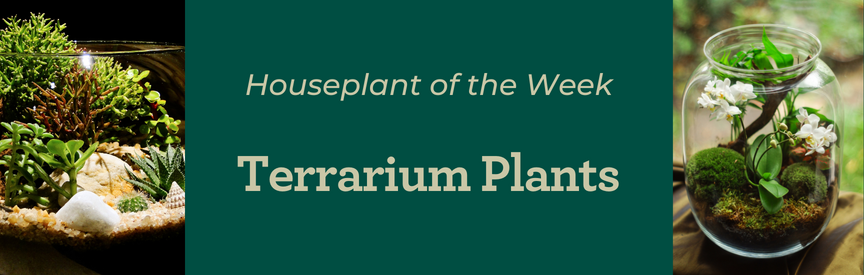
Houseplants of the Week: Terrarium Plants

Posted on by

terrarium plants

This week’s houseplant star is actually several different plants living together under glass. Highly personal and creative, a terrarium is a work of living art that can add much to your home décor – or be a terrific gift!

Simply put, a terrarium is a container, typically made of glass, that is fully or partially enclosed and filled with small plants. A fully enclosed terrarium will essentially create an ecosystem that’s self-sustaining, but some plants (like succulents) require a container that’s at least partially open to allow for airflow.

For your terrarium, you will need:

  • A container to hold your plants. This can be one specifically designed for terrarium use, but you can also use any clear glass container with a wide mouth, from a goldfish bowl to a cookie jar.
  • Small plants that don’t grow too fast. African violets, pothos, small ferns, lucky bamboo, club moss and creeping figs are all good choices. And, of course, succulents, but again we’d suggest not fully sealing the container if you do.
  • Some gravel or crushed stone
  • Sheet moss and potting mix
  • (Optional) some decorations.

Putting Together Your Terrarium

Terrariums don’t have drainage holes, so you’ll want to build up your terrarium to create a drainage layer that keeps water away from the plants’ roots. That’s where your gravel or crushed stone comes in, to give water a place to go.  Then you’ll want to use a little moss to create a layer between the stone and your potting soil. After that, add about 2 inches of damp potting soil, then the plants.

Think about what you want the finished product to look like. Arrange your taller and shorter plants so they are visually interesting. Contrast colors and leaf shapes to make them stand out – much like you do for your outside garden beds!

When you take your plants out of their containers, tease out any roots that have become rootbound. You also might want to trim the roots a bit (this retards the growth of the plant, but be careful not to cut too much back). Create holes for each plant and place the plants in the terrarium, gently patting the soil down to keep them secure and eliminate any air pockets.

Once your plants are in, you can add fun decorations to your terrarium to truly make it your own.

Houseplant of the Week: Cacti

Posted on by

Found in an amazing array of shapes and colors, cacti are those succulents that even the blackest of thumbs have a hard time killing. The cactus family (Cactaceae) is considered one of the most distinctive and specialized groups in the plant kingdom, which includes about 2,000 species!

What do you need to grow cacti? A sunny spot, well-draining soil and not much else. The big trick with cacti is not overwatering them.
All cacti are part of the succulent family of plants, meaning that their stems are designed to hold water in case of a drought. When the plant is dry it uses those reserves. But if you overwater, it can cause the plant to rot.

Critter-Resistant Gardening

Posted on by

I gave a talk at Warner’s Root Camp recently on Deer and Javelina Resistant Gardening. I thought by putting this talk together, I would have a lot more answers on what to do. We get many calls at the extension office on what do about wildlife damage in the garden. I figured all I had to do was some research.

How hard can this talk be?

Building Fences

I quickly learned that aside form a sturdy fence, there aren’t many easy solutions for either deer or javelina control. In fact, for most wildlife problems in the garden, the key to control is prevention, and exclusion is the best remedy.

But exclusion isn’t always that easy. Your HOA may not allow fences. Or the cost may be too expensive. So, before you throw up your hands and give up, let’s visit the four habitat elements that wildlife require: food, water, shelter, and space. Modifying these elements can be used to discourage unwanted visitors.

Food is a main attractant to many gardens. A colorful tulip bed is like a dessert table for both deer and javelina. And if food resources are scarce, almost any plant will do. There are some plants that both critters avoid, especially when dry conditions haven’t driven animals to eat almost anything. Butterfly bush, oaks, skunk bush and other sumacs, daffodils and daylilies are good examples.

Javelina are opportunistic eaters, and their diet can change with the availability of food. They nibble on many plants or dig up plants that they don’t actually eat. They are especially fond of prickly pear cactus, and are known to seek out flowers and fruit. One Master Gardener lost spaghetti squash to a squadron of javelina. Vegetable plants that they seem to avoid are chili pepper, cucumber, and eggplant, and most herbs. Since javelina have a keen sense of smell, maybe strong odors can keep them away.

There are no guarantees on what javelina won’t eat, so the best strategy is to put up sturdy fencing that is a minimum of two to three feet tall. At my house recently, a javelina opted for cat food as a meal avoiding all the native plants in my front yard. (Feeding wildlife though is never a good practice.)

More Options Available for Deer

There are more options when considering how to prevent damage by deer. Again, you can think about what plants deer love and what they avoid. Favorites include roses and fruit trees. They often avoid smelly plants, particularly herbs such as lavender, sage, thyme, oregano, and rosemary. Plants that have fuzzy leaves like lamb’s ear and fern-like leaves like yarrow are not preferred choices.

In combination with growing less palatable plants, repellants such as capsicum pepper, garlic and coyote urine sprayed on plants can reduce the amount of damage. These all work to some degree but varying them often makes them more effective. Frightening with outdoor lighting or noise may seem like a good idea but many animals quickly learn to ignore these methods – and it can really annoy your neighbors. Motion sensors can work but I know a group of gardeners that got sprayed by oscillating sprinklers when they accidently tripped the sensor while visiting a garden.

As with javelina, the only sure way to control deer damage is to erect study fencing ideally at least eight feet tall. Colorado State University has a great publication on preventing deer damage.

Hattie Braun is the County Director of the University of Arizona Cooperative Extension in Coconino County, and coordinator of the Master Gardener Program.

Houseplant of the Week: Caladium

Posted on by

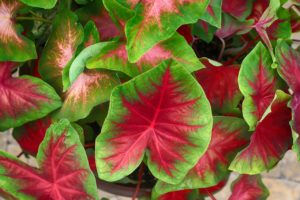
Many think of caladium as an outdoor annual, but this plant, with its dramatic array of green, red, pink and white leaves can be grown indoors as well.

However, don’t be surprised if your plant only produces leaves from spring to fall. Caladium plants require a rest period of about five months before they sprout again in spring.

Place your caladium in medium light, keeping them out of direct sunlight, which can burn their leaves.

The big challenge with these plants is that they like a lot of humidity, as they are natives of tropical forests. You can achieve this by misting or placing a saucer filled with pebbles and water under the container. As the water evaporates, it will moisten the air and provide the humidity your caladium needs to stay happy.

Tomatoes & Your Health

Posted on by

Year after year, tomatoes are the most popular home garden crop and it’s not hard to understand why. They are delicious, relatively easy to grow, and amazingly versatile. Whether you use them for sauces or soups, add them to a summer sandwich or just snack on one straight off the vine, tomatoes are amazing.

But tomatoes don’t just taste good; they’re also good for you.

Tomatoes are chock-full of lycopene, a powerful antioxidant. It’s an organic pigment that gives tomatoes their bright red color and protects them from the ultraviolet rays of the sun. Similarly, they can help protect your cells from damage. Tomatoes also have potassium, vitamins B and E, and other nutrients.

Because of that, tomatoes promote health by boosting your immune system, lowering levels of LDL cholesterol (that’s the bad type), and are good for your heart. They can even help shield you from sun damage from inside your body – but you still need to slather on the SPF 30 to avoid a sunburn.

Despite northern Arizona’s short growing season, it is possible to have lush tomato plants gracing your garden with their beautiful lycopene-filled red bulbs. Scientific selection has helped make tomatoes hardier, but you’ll need to get them planted soon to reap the benefits.

A few of our favorites at Warner’s Nursery include Better Boy, which could also be called “Big Boy,” as it often produces plump, juicy fruits that weigh more than one pound; Celebrity, which is known for its taste as well as its resistance to disease; Early Girl, which provides nice 4-to-6-ounce fruits extra early in the season; and Siberian, which can withstand cool conditions and germinates at slightly lower temperatures.

When you are considering your tomato plant accessories this year – like cages or stakes – please also think about getting season extenders. These tubes of water will surround and protect your tomatoes by absorbing the heat of the sun during the day to keep your plant warm at night. Remember, the days are lovely right now, but evenings can still be frosty!

During Memorial Day weekend, Warner’s Nursery will hold its traditional Tomatopalooza, our annual celebration of all things tomato. Stop on by to pick up some plants or ask our experts about cultivating these amazing – and very healthy – edibles.

Happy Gardening,
Misti

Houseplant of the Week: Ficus Audrey

Posted on by
Banner featuring image of the Ficus Audrey

We understand why you might be a little nervous about adopting a plant named “Audrey,” particularly if you are a fan of Little Shop of Horrors. But we promise our Ficus Benghalensis is not a bloodthirsty alien looking to take over the world.

Although now that we think about it…

In the wilds of India and Pakistan, where they are known as Banyan Trees, the Ficus Audrey can soar to 100 feet tall and grow several acres wide. They have roots that easily overtake other roots, which allows them to form a forest’s worth of canopy with just a single tree. In fact, the Thimmamma Marrimanu or Thimmamma’s Banyon Tree located in Anantapur, India, is thought to have the world’s largest canopy from a single tree, covering almost 5 acres.

So maybe not world domination, but forest domination – sure! 

Your indoor version of Audrey won’t be this expansive, but it still might grow as tall as 10 feet! In appearance, it’s very similar to the Fiddle Leaf Fig, although it’s actually easier to grow.

Here are a few tips on raising your Ficus Audrey:

  • This ficus thrives in indirect bright light. No direct sun or low light.
  • They don’t like drafts or low temperatures.
  • Make sure the top 2 to 3 inches of soil are dry before you water.

Pothos

Posted on by

It’s hard not to love the Pothos. Their easy-going nature makes them not only a great plant for your home, but a good gift for your friends or loved ones who might not think they have green thumbs.

These versatile houseplants look great in a pot or hanging in a container (they look particularly fetching in macramé hangers, which have made a comeback.) They grow well in bright light or low light, meaning they will flourish anywhere in your home.

Caring for Your Pothos – One of their very few demands is not being overwatered, so keep the top few inches of soil dry and test the soil prior to watering. You should feed them on a regular schedule from April or May through August. Just follow the instructions on the label of your favorite plant food. (We recommend VF11 organic liquid fertilizer once a month.)

Pothos love a good misting and it’s also important to dust them when needed so they photosynthesize efficiently. This also gives you a chance to inspect your plant for any pesky pests or bugs.

The Beauty of Raised Beds

Posted on by

Raised bed gardens are very popular and it’s easy to see why.

They make gardens of flowers or food easy to maintain; they can give your yard an orderly look and if your property’s soil is very poor, they are a terrific alternative.

Another reason raised garden beds are so popular is that they are ecologically sound. In a time when we are seeking to reduce, reuse and keep items out of our local landfills, raised garden beds can be created pretty easily with shipping pallets, which are plentiful.

After that, it’s a matter of cutting the pallets into wall sections, fastening them together with screws, lining them with weed fabric (which we can cut to order at Warner’s Nursery) and getting the soils and plants in.

Good soil is the single most important ingredient for a good garden. Raised beds give you an immediate advantage over a regular garden, because when you fill your raised bed, you can fill it with a blend of soil that’s superior to the native soil in your yard. Soil that’s loose and rich with nutrients and organic matter will allow the roots of your plants to grow freely, and ensure that they have access to the water and nutrients that they need.

You’ll want to prepare the area where you plan to place your raised garden bed by removing any grass or perennial weeds from the area (in fact, give the yard a good mowing before placing your raised garden bed structure there). 

Next, use a garden fork or shovel to loosen the native soil to a depth of six to ten inches; it will improve drainage and moisture retention in the beds. It also means that even if your raised bed is only about 5 inches high, you’re plants will really be growing in a space 12 – 18 inches deep, which is plenty of room for carrot, potatoes and full-size tomato plants. 

We recommend a mix of elements for your soil in a raised garden bed. Our “recipe” is: 

  • 50% mulch or topsoil
  • 40% compost (a mix of chicken manure, steer manure and a “green compost” like Warner’s Supreme or Black Gold’s Garden Compost)
  • 10% potting soil, preferably with peat most, perlite or vermiculite, which help with drainage and moisture retention.

In order to purchase the right amount of total soil, a little bit of math is involved:

  • Measure the length, width and depth of your planter (we calculate the depth as from the bottom to about two inches from the top)
  • Multiply these numbers together to get the volume. So if your bed is five feet long by 4 feet wide and 2 feet deep, that’s 5 x 4 x 2 or 40 cubic feet of soil. 

We’re always available to answer any questions you might have about constructing your own raised bed, what soil to put in it and, of course, what plants you should populate it with!

Happy gardening,

Misti

Build a Healthy Garden Soil

Posted on by

I moved to Flagstaff in 1993, promptly tried my hand at gardening, and quickly learned that I wasn’t in Pennsylvania anymore. We have many challenges here in the high country that make gardening so much more interesting than in Pennsylvania. I’ve learned that one of the biggest challenges is working with our soil.

Soils in Flagstaff and surrounding communities may be perfect for native plants but can make growing vegetables, herbs, non-native annuals, perennials, trees and shrubs difficult.

People living on the west side of Flagstaff find that their soil often has only a few inches of topsoil and the layer underneath is almost impossible to dig into as it has so much clay. Other folks find that their property sits on top of a limestone shelf. The southeastern part of town has soil with lots of rocks. Further east, soils are cindery and easy to dig into but so well-draining that watering becomes a problem. Lucky are the folks that live in the neighborhoods near Sunnyside; they actually have topsoil and even more than a foot of it.

The clayey soils on the west side of town make watering hard as water moves too slowly into the ground. In sandy or cindery soils, water moves thru the soil so quickly you can almost wonder if you even watered.

Another trial is that most soils in the Flagstaff area are slightly alkaline, particularly east of town, and when you move further east, the pH can be as high as 8. Alkalinity makes it harder for certain nutrients to be taken up by the plants. Many vegetables prefer a pH closer to 6.5.

And if that’s not enough, much of the soil structure can be compacted. Heavy equipment required for building a house can completely ruin structure. And regardless of where you live, almost all of our soils lack sufficient organic matter needed by many vegetables and non-native plants for their best growth.

Fortunately, there’s a solution to these different soil conditions; add organic matter.

Organic matter, especially compost, is the key to building healthy soil. Organic matter helps water move into clayey soils more readily, and it helps slow the movement in sandy soils. Organic matter helps to lower soil pH slightly as microbes break down the material. Organic matter can help restore soil structure and prevent it from becoming compacted again.

This does require lots of digging to incorporate the organic matter. (When soils are so dense or rocky that it’s impossible to dig, creating a raised bed may be the best solution.)

There are many options for adding organic matter to the soil: buying bagged material, collecting dried leaves, and getting manure from a neighbor. Many gardeners have a favorite. I think the absolute best is compost. Compost does everything that other organic materials do such as building better soil structure, reducing compaction, modifying pH, and aiding water retention and movement in the soil. Compost also provides microorganisms, essential for a healthy soil, and many nutrients.

Regardless of what material you choose, by adding organic matter, you can build a healthy garden soil and have a successful garden – even if it’s not in Pennsylvania.

Hattie Braun is the County Director of the University of Arizona Cooperative Extension in Coconino County, and coordinator of the Master Gardener Program. She recently taught an “Intro to Soils” class as part of Warner’s Root Camp and will be back on May 21 to teach a class on Deer- and Javelina-Resistant Gardening.