Gardening for Mental & Physical Fitness

Posted on by

I am always singing the praises of gardening.

Typically, I tend to talk about gardening as a way to beautify your home, spend time with your family and grow fabulous things – be they trees or flower beds or tasty tomatoes or veggies.

Today, however, I want to take a look at the many health benefits of gardening.

Are you looking for a fitness program that will help you with endurance, flexibility, and strength? Keep you outside in the fresh air instead of inside at a gym? Give you calmness and relaxation even as it provides a moderate aerobic workout? Gardening can do all those things!

Don’t take my word for it; the National Institutes of Health published a “meta-analysis” on gardening reviewing 22 case studies worldwide about how gardening affected people both physically and emotionally. Here’s what they found:

Studies reported a wide range of health outcomes, such as reductions in depression, anxiety, and body mass index, as well as increases in life satisfaction, quality of life, and sense of community….This study has provided robust evidence for the positive effects of gardening on health. A regular dose of gardening can improve public health.

And gardening is exercise with a purpose. Once you are done raking, weeding, turning compost, pruning shrubs, planting trees, digging holes and hauling bags of soil and fertilizer, you’ve not only given yourself a workout (to the tune of burning 200 to 300 calories an hour), you’ve also created something lovely.

But like all exercise routines, there are some things to keep in mind when you are gardening:

  • Stretch. You wouldn’t run a 5K or start lifting weights without a warmup and the same is true for gardening.
  • Alternate “exercises.” Try not to go more than 20 or 30 minutes doing one specific task. It ensures that you don’t overstress one muscle group.
  • Take plenty of breaks. It’s easy to overdo it in any physical activity and gardening is no exception.
  • Keep hydrated. Between our high altitude and the workout gardening can give you, you’ll need to drink plenty of water.
  • Make sure you are enjoying your workout. Gardening shouldn’t be seen as a punishment or annoying chore but as a chance to play in the dirt. Yep, it’s hard work, but it can also be joyful and fun.

I hope you are getting to enjoy all of the benefits of gardening this year from the workout you’ll get to the flowers and veggies you’ll enjoy all season long.

Happy gardening,
Misti

Bare Root Plants

Posted on by

Bare root plants might look a little like a bunch of half-dead stems, but today I’m going to share with you how to get the most out of these plants that are truly a great bang for your buck.

You will usually see rhubarb, raspberries, grapes and asparagus plants in bare root.

The first step is to figure out where you want your small fruits to grow. You need a location that gets 6 or more hours of sunlight per day, because fruit-bearing crops require full sun in order to produce.

Then you need to amend your soil to make it a happy home for your bare root plants. You will need fertile, loamy soil. We recommend doing a half and half of Warner’s Supreme Planting mix with your existing soil. 

After you prepare the soil, you need to prep your plants. Place the roots in a container of lukewarm water with Ferti-Lome’s root stimulator. You need about 3 tablespoons of root stimulator per each gallon of water. Arrange the plants so only the roots are in the water and leave them soaking overnight.

Now you are ready to plant. Dig a hole for each plant, just a little deeper than the roots extend. Build a small mound of soil inside the hole for each plant. Then place the plant’s crown on top of the mound and fan the roots around it. Pat your amended soil over the roots to just cover them and then fill in the rest of the hole around the mounds with your amended soil. There will be a little settling, and you want to make sure the crown of the plant is underground. 

Water the plant well and continue to water as needed to keep the soil moist but well drained. Once a week, water with some root stimulator mixed in. Again you’ll be using 3 tablespoons of the stimulator per gallon of water. It will help the plants get established. Continue for about 4-6 weeks.

And there you have it! Your bare root plants will have what they need to grow strong and healthy and provide you with plenty of yummy fruit. 

Happy Gardening!
Misti

Houseplant of the Week: Devil’s Backbone

Posted on by

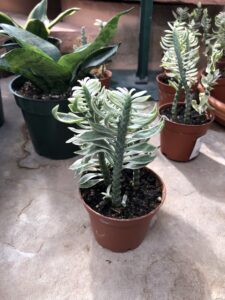
Devil's Backbone plant

In summer, the slow-growing Devil’s Backbone will sometimes develop “flowers” (really leaf bracts) that are pink or red, which gives this lovely houseplant some of its more colorful nickname’s – red bird flower and Persian lady’s slipper among them.

But most of the time, this houseplant sports variegated white and green leaves up its “spine.” Easy to grow and propagate, this plant has basic requirements and an aversion to cold.

Caring for Your Devil’s Backbone

Soil/Watering: This plant likes a nice even moisture, so in addition to a good potting mix, you might want to add a little peat most that will help spread out the water but keep the soil from being too wet. Make sure your Devil’s Backbone is in a pot with drainage holes so the soil drains well.

Light/Temperature: Room temperature and a spot out of the way of drafts is perfect. As with many tropical houseplants, Devil’s Backbone does not like the cold, but loves bright, indirect sunlight.

Food: Fertilize in the spring about every three weeks. This will help it produce those nice colorful bracts in the summer. Devil’s Backbone goes dormant in the fall and winter, so discontinue feeding at that time.

Getting Ready for Spring by Pruning

Posted on by

We are getting back into the swing of things for the upcoming gardening season. On March 12, we’ll start our annual Root Camp classes and the very first one will be about spring pruning. If you aren’t able to attend that class, here are some basic tips.

Pruning helps maintain the health of your tree or shrub when you remove diseased or dead branches, or ones that are growing into one another. It can also help increase the yield of flowers or fruit by taking energy away from unneeded foliage. Last but not least, pruning is a safety precaution by removing branches that are cracked or threatening to fall.

Late winter and early spring are the perfect time for pruning because the plants are dormant, meaning that wounds will heal faster. For deciduous plants, there’s the added benefit that it’s easier to see what you are doing because the trees are bare. However, if you have a spring blooming tree or shrub, you should ideally prune them before they bud. Otherwise, wait until after blooming has finished.”

One important rule of all types of pruning is this: never prune more than one third of the plant. Prune more than that and you run the risk of damaging the plant or at least stunting its growth. 

Types of Pruning Cuts for Deciduous Plants

Because many kinds of pruning cuts are made near a growth bud, you have to know how your plants grow in order to determine where to cut. There are three types: (1) a terminal bud grows at the tip of a shoot; (2) a lateral bud grows alongside the shoot; and (3) a latent bud lies dormant beneath the bark. If a branch breaks or is cut off near it, it may develop into a new shoot.

Once you determine the type, you can choose one of these four pruning cuts to keep it healthy.

  • Thinning – This is when you remove an entire branch or stem, taking it back to its point of origin or to a juncture with another branch. These cuts eliminate competing or old stems, reduce overall size, and open up a plant’s structure.
  • Heading – Heading cuts remove just part of a stem or branch – not the whole thing. Such cuts can be made back to a bud or to a twig and it stimulates the growth of lateral buds just below the cut. 
  • Shearing – Clipping a plant’s outer foliage to create an even surface (like with hedges or a topiary). It’s kind of an indiscriminate form of heading, because it doesn’t involve precise cutting just above a growing point.
  • Pinching – This is the simplest of pruning cuts. Using your thumb and forefinger or a pair of hand shears, you nip off the tips of new growth, removing the terminal bud. This stops the shoot from growing longer and stimulates branching. Pinching is used primarily on annuals and perennials to make them bushy and encourage the production of more flowers.

What to Do with Conifers

Part of the allure of evergreens is that they are usually low-maintenance plants. A little periodic pruning, however, can keep your conifers healthy and looking their best. When thinking about pruning conifers – or any plant for that matter – it’s good to remember the old adage, “measure twice and cut once.” In the case of conifers, it’s “think twice and prune once.” 

Here’s the really important thing to remember: there is no place for “recreational pruning” of conifers because they don’t replace growth like other trees and shrubs; pruning is always done for a particular purpose, like keeping a particular look, removing dead or diseased branches, or controlling the size if they are threatening to grow into other plants or buildings.

If you have more questions about pruning, please consider attending our class at 10 am on Saturday, March 12, or you can always contact us at the nursery – we are always happy to help!

Happy Gardening!
Misti

Root Camp: Gardening as a Team Sport

Posted on by

Spring is coming.

We can feel it in the nursery. It’s more than the fact that we’ve stocked up on seeds and soil and everything gardeners need to get ready for a new season. It’s a feeling of excitement. The days are getting longer, they’ll get warmer (eventually), and before you know it, we’ll be outdoors planting, cultivating and enjoying the fruits of our labors.

I know that some of you might be reading this who don’t feel confident about your gardening abilities. Maybe you tried gardening in the past and it didn’t work out. Because for all the rewards of gardening – and there are many – it sometimes can be a challenge, particularly in northern Arizona.

Poor soil. Persistent drought. A short growing season. Javelinas, for goodness sakes! 

But don’t worry; we’ve got you covered.

While many of us enjoy gardening as a solo activity, we at Warner’s like to think of it more as a team sport, particularly when you are new at it. We believe you’ll get the most out of your time cultivating the earth if you have coaches and fellow gardeners cheering you on and sharing their wisdom and experience.

Beginning next month, we’ll be offering that team spirit through Warner’s Root Camp, a Gardening 101 series of classes to help you build up your skills in the garden. These 15 free sessions will be offered on Saturdays at 10 am from March to July. There are classes on understanding your soil, how to plant from seed, container gardening, installing a drip irrigation system, building the perfect garden to attract pollinators, hydroponics and much more.

You can see the full list of classes here. 

We are very pleased that almost all of our 2022 Root Camp classes will be led by certified Master Gardeners, people who have undergone extensive education and training through the University of Arizona Cooperative Extension program.

These Root Camp experts will give you invaluable tips and tools you need for gardening success. And they aren’t the only members of your gardening “squad.” Our Warner’s employees are also on hand every day to answer your questions and provide guidance; just give us a call or visit us down at the nursery.

Working together, we think we can provide you with a winning gardening season this year. 

Go team!

Happy Gardening,
Misti

Houseplant of the Week: Watermelon Peperomia

Posted on by

Looking for an easy indoor plant that doesn’t take up too much room and comes in a wide range of colors and varieties? Then you might want to pick a peck of peperomia.

There’s well over a thousand varieties of these plants, but one of our favorites is the P. argyreia, whose silver stripes against dark green leaves make it look like a watermelon skin!

Peperomia tolerate low light relatively well, but they will be happiest in medium to bright indirect light. But don’t allow direct sunshine to hit those beautiful leaves; if given too much light, the colors and patterns that make this plant so special will fade.

Water your Peperomia sparingly. Wait until the top 50% – 75% of the soil is dry, then water until liquid flows through the drainage holes at the bottom. Discard any water that has accumulated in the saucer. Many types of Peperomia can hold water in their leaves, so it’s not a death sentence if you go on vacation or forget to water them once in a while.

Terrarium Fun!

Posted on by

For houseplant lovers, one of the most fun projects you can do is create a little miniature “garden under glass,” better known as a terrarium. We’ll be holding a terrarium workshop later this month, but I wanted to give you a preview of what goes into creating this beautiful item that can add so much to your décor – or be a terrific gift.

Simply put, a terrarium is a container, typically made of glass, that is fully or partially enclosed and filled with small plants. A fully enclosed terrarium will essentially create an ecosystem that’s self-sustaining, but some plants (like succulents) require a container that’s at least partially open to allow for airflow.

These mini-gardens can be quite creative, featuring decorations as well as plants.

What Do You Need for a Terrarium?

First off, you need a container to hold your plants. There are specifically designed containers for terrariums, but you can also use any clear glass container with a wide mouth, from a goldfish bowl to a cookie jar. You’ll also need to select small plants that don’t grow too fast to populate your terrarium. African violets, pothos, small ferns, lucky bamboo, club moss and creeping figs are all good choices. And, of course, succulents, but again we’d suggest not fully sealing the container if you do.

You’ll also want some gravel or crushed stone, a little sheet moss, potting mix and – to make it really fancy – some decorations.

Putting Together Your Terrarium

Terrariums don’t have drainage holes, so you’ll want to build up your terrarium to create a drainage layer that keeps water away from the plants’ roots. That’s where your gravel or crushed stone comes in, to give water a place to go.  Then you’ll want to use a little moss to create a layer between the stone and your potting soil. 

Add damp potting soil next – at least two inches. You don’t want to put too much soil in, however, because you need to leave room for your plants to grow without touching the top of a closed terrarium.

Now the fun part – start planting. Think about what you want the finished product to look like. Arrange your taller and shorter plants so they are visually interesting. Contrast colors and leaf shapes to make them stand out – much like you do for your outside garden beds!

When you take your plants out of their containers, tease out any roots that have become rootbound. You also might want to trim the roots a bit (this retards the growth of the plant, but be careful not to cut too much back). Create holes for each plant and place the plants in the terrarium, gently patting the soil down to keep them secure and eliminate any air pockets.

Once your plants are in, you can add fun decorations to your terrarium to truly make it your own.

Terrarium Workshop

Terrarium building is even more fun when you get to do it with other plant enthusiasts. That’s why we’ve scheduled a terrarium workshop for Saturday, Feb. 19. You’ll get all the materials you need to create your terrarium, plus complimentary coffee, tea or wine. Learn more about it here.

Happy Gardening, 
Misti

Houseplant of the Week: ZZ, the Eternity Plant

Posted on by

We’ve been doing the research but we don’t know quite how Zamioculcas zamiifolia (say that three times fast) got one of its nicknames.

Not “ZZ” (that one’s kind of obvious) or “Fat Boy,” which come from the tubby little rhizomes under the soil, but its very popular name, the “Eternity Plant.”

We’re guessing, however, that it’s because you can’t kill it. Or at least you’d have to try really, really hard.

This is one of the most forgiving plants you’ll find in our nursery. Miss a watering (or three) and it still shows off it’s glossy, feathery wings. It’s not particular about soil; anything that drains well will do. It’s not even fussy about light, which makes it very popular in places where there’s little natural light, like an office cubicle, or cities where most days are overcast. It also has no identified pest or disease problems.

No wonder this beauty is the star of so many Instagram posts!

Are there any downsides? Well, yes. Much like our recent houseplant of the week, Dieffenbachia (or Dumb Cane), your Eternity plant can be an irritant to sensitive skin. You don’t need to wear gloves around it, but you probably should wash your hands thoroughly after touching it, and you definitely shouldn’t consume it, so keep it away from pets and small children.

Caring for Your Eternity Plant

  • Light: As mentioned, “ZZ” is pretty tolerant of any lighting situation, but it does its best with bright but filtered light.
  • Water: The bulbous rhizomes under the surface contain water, which is why your Eternity plant will forgive you for missing a watering, but also be careful not to overwater, because that will cause the rhizomes to rot. You’ll know if you have overwatered because the leaves will start to turn yellow.
  • Fertilizer: Feed once a month during the spring and summer growing season.

Monstera Peru

Posted on by
Banner with detail of monstera peru leaves and a monstera peru plant in a white planter

Imagine crossbreeding a monstera with a succulent. What you would most likely get is a Monstera Peru.

This plant looks quite different from your typical Monstera. It’s thick, glossy, leathery leaves do not have holes or splits like a Monstera delicosia. Instead they are solid and dramatically veined. They also are why this Monstera is pretty drought resistant, despite being a tropical plant.

That doesn’t mean you shouldn’t water yours regularly, but we recommend waiting until the two top inches of soil are dry to avoid overwatering.

Monstera Peru originates from the Amazon region (thus the name, although in addition to Peru, many of these plants can be found in other parts of the Amazon basin, like Venezuela.) They like bright, but indirect light and direct sunlight can burn those beautiful leaves.

Another benefit of this plan is that while it can grow to six or eight feet, it does so slowly, so it won’t outgrow your space for quite some time.

As an epiphyte, the monstera Peru naturally likes to climb, so a little trellis can be a good idea, but you can also have the leaves trailing down.

Planning Now for Veggie Garden Success

Posted on by

With cold days and snow ahead of us, it might seem a little early to start thinking about this year’s vegetable garden, but now is the perfect time to start planning so that you can start preparing for the garden you want this summer.

Northern Arizona Gardeners have two big challenges every year as they work to get their veggie gardens growing. The first is our high elevation and the second is a shorter-than-average growing season. We barely have 100 days where it doesn’t dip into freezing temperatures overnight.

The good news is that with a little prep work outside and some seed starting indoors, you can still enjoy the whole range of cool- and warm-weather veggies.

Getting the Ground Ready

First off, identify and prepare your planting space. It doesn’t have to be huge, but for vegetables, you want a spot with at least five to six hours of full sun.

You also need good soil. Rich soil that drains well and has a proper mix of nutrients is crucial to successful gardening. Unfortunately, bad soil is rampant throughout northern Arizona, but the only way to be sure is to test your soil. (We have DIY kits here at Warner’s). The tests will let you know what amendments you might need to improve your soil.

If your soil won’t support a garden, however, consider creating a “raised” garden bed. You’ll want to fill the bed with a mix of topsoil, compost and other organic materials like manure to give your plants that nutrient-rich environment that is so important for their growth.

Note for condo/apartment dwellers: Just because you don’t have a yard does not mean you have to give up on dreams of home-grown goodies. Container gardening will work but we’d recommend choosing varieties that are bred to grow in small spaces. Anything with the words patio, pixie, tiny, baby or dwarf in their name is a good bet. And just because a plant is bred to be small doesn’t mean the fruits will be small or the yield will be less. 

Growing from Seeds in Early Spring

While you are getting your soil ready in your yard or building your raised bed, you can start your plants off inside your home from seed.

The first step is to get the right supplies. In addition to the seeds, you’ll need containers, soil and eventually, fertilizer. Seed trays are probably the easiest and most convenient way to start off your garden.

Resist the temptation to repurpose houseplant soil or just get dirt from your garden. Instead, invest in a “seedling mix” that is specifically formulated to help grow seeds and is typically a lighter soil, which makes it easier for seedlings to break through the soil once they germinate.

When you see the first true leaves appear, you’ll want to add some fertilizer to provide nutrients and make sure they are getting the sunshine (or lighting system) they need to grow.

Transplanting

As we get further into spring, watch the weather and look for a period with no frost in the forecast, probably around late April. This is a good time for “cold-season” veggies, such as broccoli, cauliflower, cabbage, kale, lettuce and spinach to move outside. You’ll want to wait until May to transplant warm-season vegetables like eggplants, tomatoes, peppers and squash.

Here’s a trick you might want to try as you transplant your vegetables: expose your seedlings to the elements gradually before moving them to their final container or garden bed. One way is to leave the seedlings out during the day and bring them back in at night so they can adjust and “harden” to the elements.

Remember that northern Arizona weather is changeable. You might need to cover your newly planted veggies with frost cloth on certain nights. Or you can use season extenders, tubes of water that surround an individual plant. The water in the tubes heats up from the sun during the day and keep the soil beneath the plant and the air around it warm.

While we are talking about protecting your veggies, another important aspect is keeping our wildlife friends out of your garden. If you think the deer love your flowers, imagine how all the members of the woodland community will feel about your vegetables. So when planning out your space, leave some room for a protective fence. 

Watering

Finally, once those beautiful plants are in the ground, please remember to water them regularly.

Without regular water, vegetables will not fill out and some, like tomatoes, will crack open if they suddenly plumped up with water after struggling without.

The main point here is that you can’t always rely on rain. So part of your planning process is to think about the best way to water regularly. We are big fans of drip irrigation. The newer component systems are really quite easy to install and cost a lot less than most people think. Plus, you’ll save money on water, because unlike handwatering, drip irrigation goes directly to the plant’s roots. You lose less water to runoff and evaporation.

We wish you the best of luck as you start planning your garden this year. If you have any questions, please stop by the nursery or give us a call. We’d love to help.

Happy Gardening, 
Misti