A Very Special Blood Drive

Posted on by

Mark your calendars – on Friday, September 18, you could help save a life.

That’s when Warner’s Nursery will be having its second blood drive of the year in the safe and super comfy Vitalant bus in our parking lot.

It’s unusual because we typically just have one annual drive around the July 4th holiday. We decided to add a second one this year for several reasons.

First of all, we had a tremendous response to July’s blood drive. Within days of announcing it, all our appointments to give blood were filled up. At the same time, there’s still a huge need for blood. Many blood drives have been cancelled during this era of COVID-19 (although it is safe to give blood – more on that below).

Avari

But probably the most important reason for this special drive is a little girl named Avari. She’s who this blood drive is in honor of and for us, it’s personal; Avari is the beloved step-daughter of one of our employees. 

When Avari was born in February 2011, she seemed to be in perfect health, a happy and adorable baby. But after about a month, she developed a persistent cough and fever. A blood test showed that her red blood cell count was dangerously low. The very next day, she was at Phoenix Children’s Hospital for a blood transfusion. 

Avari’s had almost 100 blood transfusions since then. She suffers from Diamond Blackfan Anemia, a rare condition that means her bone marrow doesn’t produce red blood cells. As her mother puts it: “Ava lives on borrowed blood.”

Donations – Safe to Give While Saving Lives

When we have our special blood drive from 9 am to 5 pm on Friday, September 18, you’ll not only be making a difference in the lives of people like Avari, you’ll be safe doing it.

We know that it’s a scary time, and if you are hesitant about donating blood now, we want to reassure you that there’s no inherent risk of coronavirus from the blood donation itself.

Additionally, Vitalant is taking precautions to ensure the well-being of donors and its staff. All donors and staff will be required to wear masks. Social distancing measures will be enacted, which is why we are asking everyone to make an appointment. Vitalant will also be continuously sanitizing the bus, wiping down all high-touch areas often and after every collection.

Being a blood donor is it’s own reward, but there are a few other benefits you’ll get when you donate on September 18:

  • A voucher for a free pint of frozen custard from Culver’s.
  • A coupon for 15% off all your purchases that day on regularly priced items at Warner’s Nursery.
  • Entry in a drawing for a $25 Warner’s gift certificate

To schedule your appointment, go to bloodhero.com and use the code “warners” or give Vitalant a call at 877-25-VITAL. Thank you so much and we look forward to seeing you on Sept. 18.

Happy Gardening,
Misti

Mushrooms: Good or Bad?

Posted on by

With the wet weather, we’ve been getting more questions at the nursery about whether mushrooms are good or bad for your garden.

My reply? Don’t fear the fungi.

Mushrooms actually are a friend, not a foe in your garden. Basically, they break down complex organic materials like dead leaves and wood chips. This turns them into substances plants can absorb.

Not that you see any of this. What you think of as a mushroom is the “fruit” body of the plant. There’s a bunch of stuff happening below the soil’s surface that is good for your garden.

How mushrooms help

Mushrooms have filaments called hyphae that spread out into the soil and interact with nearby plant roots. This interaction increases the roots’ surface area, which has a whole host of benefits, such as:

  • An increased ability to suck up water and nutrients from the soil
  • Improved drought tolerance
  • Improved disease resistance
  • Reduced stress from weather conditions and transplant shock

In fact, mycorrhizae are often used to improve poor soil. If you are seeing mushrooms, it’s an indicator that your soil is healthy. 

Generally, I’d leave your mushrooms alone with one big exception: if you have pets or small kids who are out and about in your garden. Ideally, you’ll want to teach your kids to stay away from mushrooms and limit your pet’s access, but that isn’t always possible.

Some mushrooms are toxic, so if it’s likely your children or pets will get into your garden, you might want to pull them as you see them.

Mushroom superpower?

Scientists think there’s another superpower mushrooms have, although it probably isn’t playing out in your garden: they eat plastic.

I’m not kidding. In the past decade, there have been two academic studies that have shown that certain mushrooms, such as the Pestalotiopsis microspora found in the Amazon, will break down and “eat” plastic. They also don’t require oxygen to live.

Think of the possibilities. A layer of this super mushroom at the bottom of a landfill could decompose the waste in a matter of months. Natural decomposition would take decades, if not centuries.

So I think when you see some mushrooms, you should give them a little salute. Not only are they making your garden better, the might be a secret weapon in helping our environment. 

If you have any questions about mushrooms or anything else going on in your garden, please stop by and ask. Our friendly experts are always ready to help.

Happy Gardening,
Misti

Houseplant of the Week: Ponytail Palm

Posted on by

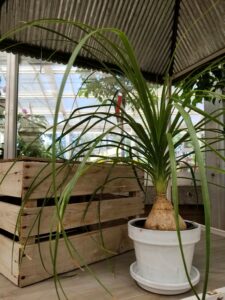
Ponytail PalmThis week’s Houseplant of the Week, the Ponytail Palm Tree is definitely beautiful, but it has a secret. It’s neither a palm nor a tree.

In fact, the Ponytail Palm actually is a member of the Agave family, which makes it a succulent.

It’s popular for many reason. First is that expansive beauty that just makes it a great addition to a home or other indoor space.

Another plus for our little imposter is that it’s super easy to care for. It can go some time between waterings, making it a favorite of folks who don’t have a lot of time for plant maintenance or who travel on a regular basis. (We realize that, right now, traveling on a regular basis isn’t a part of our lives, but it will be again some day.)

Caring for Your “Ponytail Palm”

  • Light – Technically, the Ponytail Palm needs sun, sun and more sun (or some form of bright light). However, did we mention this is a very forgiving plant? You could give it low light for half a year and then bright sunlight the other half and it would still be happy. That’s really helpful during the winter.
  • Water and Humidity – As mentioned above, you can wait two or three weeks between waterings. Make sure to let the soil dry out completely in between waterings. Also, they like their air dry.
  • Temperature – Don’t leave your Ponytail Palm out in the cold. They are a bit sensitive to temperature and thrive when it’s anywhere from 60 to 80 degrees. But definitely keep it away from the A/C vents!
  • Fertilizer – A general fertilizer works, but only once in spring and once in the summer. Too much food may lead to brown leaves. If you get brown leaves, use sharp scissors to just off the discolored part of the leaf.

Pollinators Need Us (and we need them)

Posted on by

Today I want to have a serious talk with you about the birds and the bees. 

No, not that talk. That talk you probably had years ago and, in any case, I’m not your Mom.

All joking aside, birds and bees (and butterflies) do need to be discussed seriously because they face incredibly challenging times. Pollinators are responsible for one out of every three mouthfuls of food we eat, but their numbers have been in serious decline for decades.

The Monarch Butterfly population has plummeted by something like 90 percent, mostly due to the loss of milkweed along their migratory route. Bee colonies have collapsed, victims of loss of habitat, pesticides and disease. The U.S. Fish & Wildlife Service says more than 20 species of pollinator birds are on the Endangered Species list.

But together, we can help, either by creating more gardens or making some changes in existing gardens so they are more friendly to birds, bees and butterflies.

You can expand pollinators’ garden habitats by planting at least three different pollinator-friendly plants that bloom in three different seasons (spring, summer and fall) to help ensure a consistent food supply. 

Towards the end of summer and beginning of fall, your best pollinator attractors include: Rudbeckia, Gaillardia, Catmint, Coreopsis, Agastache, Monarda, Lavender, Penstemon, Yarrow, Echinacea, Summer Phlox, Trumpet Vine, Russian Sage and, of course, Butterfly bushes.

Adopting some other strategic choices in your garden will help pollinators thrive as well. You can:

  • Create habitats for pollinators by supplying necessary water, food, shelter and places to raise their young. A great example is a “bee condo,” which you can make or purchase. 
  • Plant in clumps as clustering plants makes them easier to find and shortens the need for travel, reserving the energy of backyard pollinators.
  • Choose a variety of colors and shapes, as different pollinators are attracted to different types of flowers. (For example, flat petal flowers for butterflies, who “taste” with their feet; funnel-like flowers for hummingbirds; yellow and blue flowers for bees, who have difficulty seeing red.)
  • Use pollinator-safe pesticides and follow the directions for use carefully.

Warner’s locally grown native plant selection, as well as all the other quality plants from our nursery, provide multiple food sources for pollinators. Not only will they keep your local pollinators well fed, they’ll also keep your garden and yard looking lovely too.

Stop by and let us know if we can help.

Happy Gardening,
Misti

Finding ‘Normal’ in the Garden

Posted on by

We’ve made it to summer, hopefully safe and sound.

In a year as crazy as this one has been, one of the few sanctuaries for “normal” that we have left is our gardens. Being outdoors, growing things, even weeding for goodness’ sake, can be an escape during these times. 

Everything in the news from pandemics to politics is almost designed to make our hearts race each and every day. At the same time, the shutting down of so many of our favorite summer activities (big yard parties, movies, anything involving people not in your immediate household) can make this year feel crushingly boring.

Gardening can help with both, getting you away from the immediate concerns of the day and giving you a place to expend all that pent up energy. It keeps you active, but at your own pace. There’s always projects to work on, but very few hard deadlines.

(Except for watering and feeding your plants, of course. That’s definitely on a deadline, otherwise it’s your plants that will be dead.)

Being outdoors in your garden also gives you another “room” to take advantage of in your house. Which, if you’ve been trapped inside with your family for the past four months, is essential right now.

In fact, that’s a great project to work on during the summer: creating a new outdoor space to give your family a new setting to enjoy.

And, eventually, we’re going to be able to socialize more closely and have those big BBQ or outdoor cocktail parties. Won’t it be nice to have an inviting space already made for those events?  

Creating an outdoor “room” also provides a place to get away from our screens. Much of our lives now have to be conducted on Zoom and the like. Getting in the garden and away from your laptop or smartphone – even for just 15 minutes – is the pause that refreshes.  

So take a look at your garden, patio or yard and think about how you can enhance them this summer. If you need any advice, give us a call or visit at Warner’s Nursery. We’d be happy to help.

I hope you have a safe and fulfilling summer. 

Happy Gardening,
Misti

Watering Well

Posted on by

Here’s a scene that plays out pretty frequently at the Nursery. A gardener comes in to ask about their dying outdoor plants. In the course of conversation, it will become apparent that the problem is their plants simply aren’t getting enough water.

The gardener is shocked. “But I water my plants all the time,” he or she will insist.

Well…it’s likely that a couple of things are happening. One is that the plants need water more frequently than anticipated (for example, a plant in a container outside should be watered two or three times a day, and for hanging plants that might be more in really hot or windy weather).

More often, the issue is that the plant is being watered incorrectly. So here are some tips on how to make sure your plants are getting enough moisture:

First of all, always water the plant prior to planting, otherwise the root ball will harden as it dries. That means every time you think you are watering your plant, it’s actually going around the root ball and saturating the surrounding soil. It looks like it’s wet, but the root ball is dry.

And here’s a handy rule of thumb for new plants: the bigger the plant and its leaves, the more water it will need on a regular basis to maintain itself.  New plantings should be watered up to two times a day and, like container plants, should be watered more frequently if it’s excessively hot or windy.

The bottom line is that new plants cannot be left for days without water;  most won’t even last a single day without it.

Another thing that trips people up is when to water during cold weather. You still have to do it. Even if the plant has gone dormant it cannot survive more than a couple of weeks without water. Setting a schedule for winter watering the first three years is imperative. This is when your plant “establishes” itself, meaning its roots move out into the native soil. 

That leads us to drip irrigation which, if you’ve ever read this blog before, you’ll know we are big fans of here at Warner’s Nursery.

The gradual and easy watering of drip irrigation is a great blessing to your plants and here’s why:

  • Drip irrigation teaches the roots of your plant to grow deep and ensures that the entire root ball is saturated every time you water.
  • It saves both money and water. When you water with a hose, something like 400 gallons per hour can come out, but a lot of that water is being wasted. It rushes out at such a high rate that only the surface of the soil is reached; it never penetrates more than an inch or two and certainly not down to where the roots need it.
  • It’s way more efficient than the alternatives. Drip irrigation has an efficiency of 95% compared to 50% for overhead sprinklers or hand watering. 
  • It lets your plants “breathe.” We’ve been spending all this time talking about water, but roots need air too. Most garden plants will drown if the roots are submerged in water for a period of time. Sprinklers and hand watering produce puddles that can displace air in the soil. If the puddles do not have a chance to drain quickly, any plants with their roots under water can be stressed or die. Because drip irrigation works slowly, drop by drop, it never displaces the air in the soil.

And here’s the really good news: drip irrigation isn’t as expensive as you may think. For 100 feet of watering, it will cost you a few hundred dollars to have a system professionally installed or you can DIY it for about $100. And if you think of the gallons of water you won’t be wasting (and the plants you won’t have to replace because they’ve died of thirst), it’s likely you’ll recoup that money pretty quickly.

Please stop by or give us a call if you have any questions about drip irrigation or how you can better water your plants to keep your garden lush this summer. We’d love to help.

Happy gardening,
Misti

Houseplant of the Week: Rubber Tree

Posted on by

Tall, dark, handsome and super easy to grow: what’s not to love about a rubber tree plant, the first of our ficus trifecta.

(The other two are the Ficus Benjamina and the Fiddle Leaf Fig; click on their names to read more.)

With it’s beautiful dark glossy leaves, ficus elastica is one of the easiest varieties to cultivate. It doesn’t drop leaves and doesn’t demand much maintenance.

It also grows fast. In nature, rubber tree plants can grow to up to 80 feet, so if you keep re-potting this houseplant into bigger and bigger pots it will get wider and taller. However, If you limit it to a 10-inch diameter pot, you should get a nice 3- to 4-foot tall plant.

Rubber plants love light but keep it from direct sunlight that might burn its leaves. Do not attempt to grow this in a spot with low light; you’ll be disappointed.

Water your rubber tree about once a week during the spring and summer and every two weeks in fall and winter. Good potting soil will make your rubber tree happy. Use fertilizer sparingly – maybe once in the spring and once during the summer.

Also, do not be alarmed by some root structure that you might see at the base of the plant. Your plant is not trying to climb out of its pot; these are “aerial” roots and perfectly normal.

Gardening Sustainability: The Greener Good

Posted on by

Last month, we celebrated the 50th anniversary of Earth Day. You might have missed it, given all the focus on Covid-19, but it was an important milestone. Think about how much has changed in our view of the ecology in the past five decades: we reduce, reuse and recycle; lower our carbon footprint; and work to conserve water.

What we choose to plant and how we choose to maintain is another way we can be ecologically sound.

It starts with picking the right plants for your garden. Select plants that are well suited to your area, keeping in mind climate, sun exposure and the amount of rainfall the area gets. Additionally, you need to consider plants that are disease- and insect-resistant (Potentilla and Russian Sage are great choices). This will lessen the need to be dependent on artificial insecticides or fungicides. 

How you plant also will help some of the most important (if tiniest) gardeners on the planet – bees, birds and butterflies. Most of our flowering plants and about a third of the food we eat are due to these horticultural dynamos. So plant flowers that appeal to these pollinators throughout the year, like crocus in spring, snapdragons and foxglove in the summer, and zinnias and asters in the fall.

The way you feed and water your garden can also help the earth. Look into drip irrigation, which has several advantages over hand-watering and sprinklers because it puts the water exactly where it is needed. It also delivers water at a rate that the soil can absorb it; often hand-watering and sprinklers shoot out water too fast, meaning it is lost to run off or evaporation. 

The other way to be water wise is to take advantage of what nature already offers us – free water in the form of rain. Monsoon season is coming up, and for the cost of a rain barrel and a regulator, you can capture that rain and use it to water your garden. 

Feeding your garden can also be done in an environmentally responsible way. Compiling organic material such as food waste, leaves, grass, twigs and lawn clippings in a bin where they can decompose and then be added to your garden as a soil amendment will help feed and naturally protect your plants.  Adding composted material to your soil helps to increase drainage and support microorganisms that are beneficial to your garden. Doing so also reduces the amount of waste that winds up in our local dumps.

And last, but not least, you can show your commitment to the ecology by doing some of the most humble work in gardening– weeding and keeping debris out of your yard. We all know that every summer, northern Arizona is vulnerable to wildfire. Maintaining your yard and getting rid of green waste helps reduce the fuels that fires feed on.

We at Warner’s Nursery are available if you have any questions on how to make your garden more ecologically sound. We’d be happy to discuss this or any other tips for sustainable living in your garden or landscape.

Take care,
Misti

Houseplant of the Week: Burro’s Tail

Posted on by

Burros Tail hanging plantIf you need a cute hanging plant that will add a lot of character to your outdoor patio or a really sunny nook of your home, we highly recommend Burro’s Tail.

It’s fleshy, overlapping conical leaves make it look like a braided tail. Those stems can grow to two feet and during the summer (the one pictured here is a baby; if they have the room to really grow those stems, Burro’s Tail can sometimes look like the plant version of Cousin Itt from the Addams Family). In summer, the stems have pink or red flowers at the ends. 

Scientifically known as the sedum morganianum, the Burro’s Tail likes full sunlight for growth and to enhance the blue-green or green-gray leaf color.

In terms of maintenance, it’s a typical succulent. It prefers gritty, well-draining soil and moderate watering, except in winter when you should cut back. You’ll want to let it dry out between waterings, as excess water will damage this plant easily.

You can propagate a Burro’s Tail either from the stem or leaf cuttings; the leaves are very delicate and break away easily. 

What Mom Wants this Year

Posted on by

So what does Mom want this Mother’s Day?

That’s kind of a thorny issue this year because all of the things that you’d typically give a hardworking Mom on her special day are not options in the era of COVID-19 and social distancing.

A relaxing massage? Well, since you can’t exactly provide that as a curbside service, it probably won’t work. The traditional mani-pedi? Same problem. Dinner at a lovely restaurant with great vibe? Well, you can visit it and soak up the atmosphere for about three minutes while you wait for your takeout order. It’s just not the same.

And even those cute gifts that your kids make at school, those adorable crafts that just make your heart sing – well, the kids aren’t in school and it might be hard to get the cardboard, yarn and tissue paper needed to make them at home. 

So I think the big thing is to focus on what I believe most mothers want (because it’s what I know I would want this year): more quality time with the family.

Now I can hear you saying, “Wait a minute. I’ve been 24/7 with my spouse and children for the past six weeks. How much more togetherness can we possibly stand?”

But notice I said quality time. Time relaxing and just enjoying each other’s company. Time doing things that are fun and engaging. Time that isn’t dictated by what you “have” to do (like homeschooling or chores) or what you do just to idly pass the time because you are stuck in your house (hello, Netflix binges.)

So this year, maybe don’t stress the gifts so much. Aim for the activities that she loves, in order to show her your love.

And here’s where I’m going to do a plug for gardening. There’s nothing like giving Mom flowers that will last all season long and playing in the dirt together. Or maybe getting those tomato plants started – fun and yummy.

Or planting a new tree. That’s a real sign of hope in a scary time, isn’t it, planting a sapling that won’t reach maturity for a while. What a way of saying that you believe tomorrow is going to be better.

Gardening will get your whole family outdoors in the clean, fresh air. It will let you soak up the sun. And it will put you in contact with the beauty of living things.

We’d love to help you pick out the perfect items for Mom (from a distance of course) or fill a curbside to-go order of plants for you. 

I hope everyone has a very, very happy Mother’s Day next Sunday. 

Happy gardening,
Misti